Tools Are Not Talent
Untangled Tuesday

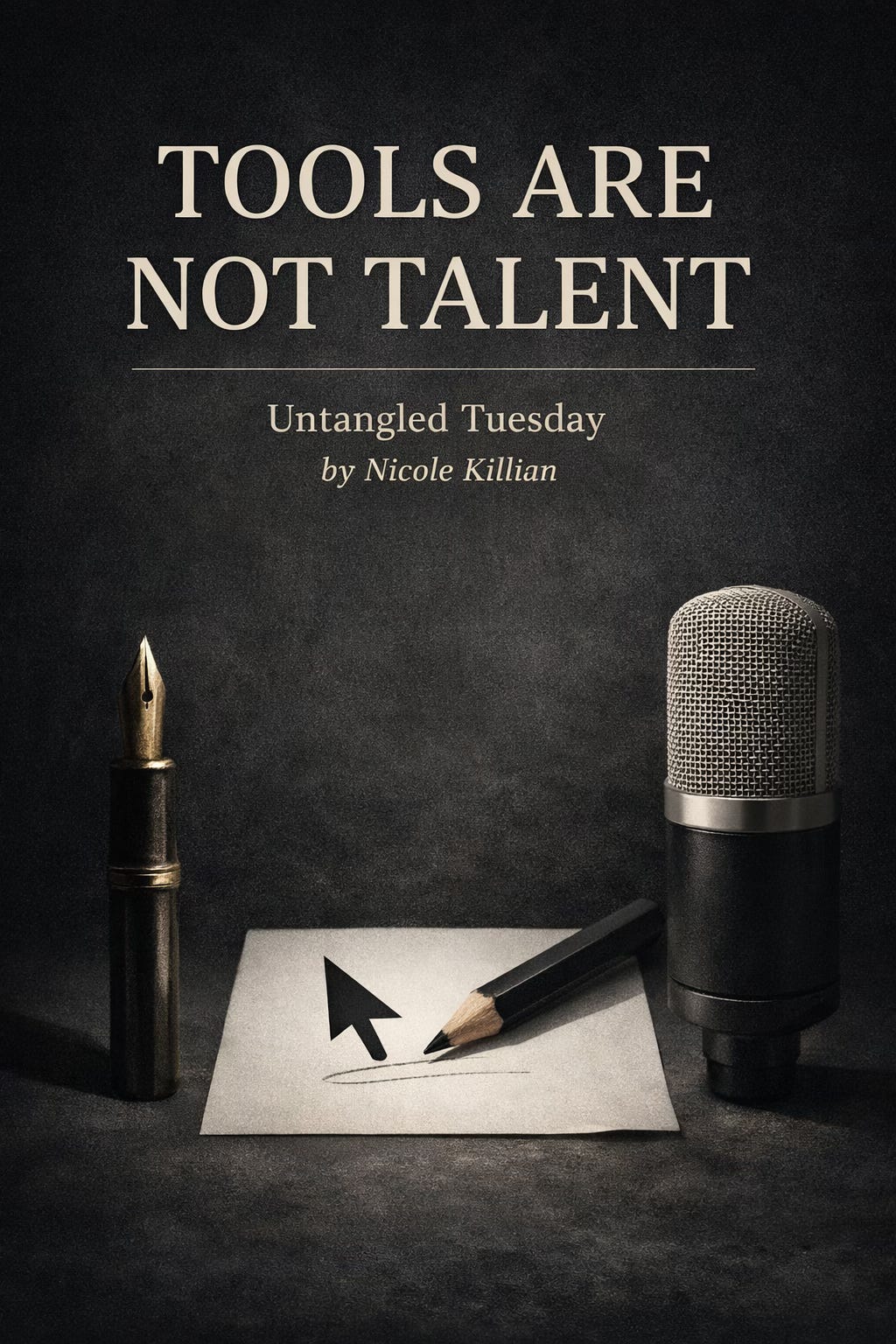
There is a strange panic happening in creative spaces.
It whispers first. Then it accuses.
Was that written by AI?
Did you use autotune?
Did you trace that?
Is that generated?
Somewhere along the way, we started acting like tools were crimes. I do not understand the fear. I understand caution. I understand ethics. I understand environmental concerns, intellectual property debates, and the fact that large systems require large resources. Those are serious conversations. They deserve nuance and responsibility.
But what I do not understand is why we shame people for creating. We live in a world where people consume twelve hours a day and create nothing. We scroll, we binge, and we watch other people build entire lives online while we sit in the glow of a screen pretending that observation is participation. Then, the second someone uses a tool to actually make something, we accuse them of cheating. Make it make sense.
We exist to create.
That is not poetic fluff. It is a psychological reality. When human beings stop making things, we do not become enlightened; we become depressed, we spiral, and we feel small. Creation is how we process experience. It is how we metabolize joy, trauma, boredom, and love. It is how we leave fingerprints on time.
And now we have tools that sit at our fingertips, capable of amplifying that instinct, and people want to act like using them disqualifies you.
Let us talk about collaboration. No one shames an author for having an editor. No one gasps when a singer hires a producer. No one storms into a gallery and says, “I refuse to look at this because you used better brushes than Michelangelo.” Collaboration with humans has always been normal. In fact, it is celebrated.
When you collaborate with a human being, you gain perspective. You gain expertise. You gain emotional intelligence that a machine does not possess. A human collaborator can challenge you, argue with you, and sharpen your ideas. They can understand subtext and lived experience in a way that is deeply personal. They can bring history, intuition, and relational nuance to the table.
The downside? Humans have schedules. Humans have egos. Humans have limits. Humans require money, negotiation, compromise, and sometimes creative surrender. Collaboration with humanity is powerful, but it is not always accessible. Not everyone has a producer. Not everyone can afford a ghostwriter. Not everyone has a band waiting in the garage.
So what happens when someone who has ideas but no orchestra wants to make music?
Do we tell them they are not allowed? I love to sing. I have always loved to sing. But I cannot play an instrument to save my life. I was in band for three years, and I probably could not pick a trumpet out of a lineup today. Does that mean I do not get to create my own music? Does that mean I have to wait for someone more talented to decide I am worthy of a melody? No.
It means I use tools.
Autotune is a tool. Digital production is a tool. AI-generated instrumentals are tools. They do not replace my voice. They support it. They frame it. They give it a place to exist.
If someone proudly announces that they refuse to listen to music with autotune or read anything that involves AI, I genuinely hope they enjoy their time in the dark ages. Not as an insult, but as a reality check. To be the bubble breaker for a moment, there is computer work, AI assistance, autotune, digital editing, Alexa, Siri, Google, or some form of technological collaboration in virtually everything we touch. The film you love was color graded by software. The book you cherish was formatted on a computer. The song you claim is “pure” was mixed, mastered, filtered, and polished through digital systems. If someone hears my song and says, “I can tell you used autotune,” I hope you can! Because I think that made it better. And here’s another little secret for you: all my backup singers are AI.
Now, let us talk about AI collaboration specifically. AI is not talent. It is a tool.
When an author uses AI to brainstorm, to structure, to tighten language, or to experiment with ideas, the original thought still has to come from somewhere. The voice still belongs to the human. The lived experience, the conviction, the worldview, the story, those are not downloaded from a server. They are carried in the body.
There are pros to collaborating with AI. AI is accessible. It is immediate. It does not judge your rough drafts. It does not get tired at midnight. It can help you outline a novel, experiment with different tones, suggest variations, generate instrumentals, create cover art, mock up room designs, write code for your website, or help you think through a business plan.
It can amplify the productivity and creativity that already come from you.
Back in Shakespeare’s day, only a small percentage of people could tell their story with passion, detail, and an audience. Literacy was limited. Publishing was gatekept. Stages were exclusive. If you were not born into the right circle or granted access to the right patron, your voice likely never left your village.
Now the stage is global. You can publish a poem in a matter of seconds. You can release a song from your bedroom. You can design your own book cover, your own website, and your own brand. Why would we not use the tools handed to us to keep up with that demand?
If everyone has access to the stage, the pressure to perform increases. The speed increases. The volume increases. AI can help you refine, scale, and sustain your output without burning out. It can help you test ideas before you invest months of your life into them. It can help you polish what is already yours.
But there are cons too. AI lacks lived experience. It does not suffer. It does not love. It does not understand context beyond patterns. If you rely on it entirely, your work can become hollow. It can sound like everything else. It can lose the friction that makes art human. AI makes a good collaborator, but it cannot create without your direction. AI must also live by certain community guidelines, so the controversy, maturity levels, and experience must be entirely personal.
There is also the environmental concern. Yes, AI uses significant resources. Yes, data centers require water and energy. Those are real considerations. Many systems use recycled, non-potable water for cooling, which complicates the argument but does not erase it. We should care about sustainability. We should demand better infrastructure and responsible development.
The answer to environmental concerns is innovation and accountability, not creative paralysis. Shutting down individual creators will not fix infrastructure. Demanding better systems will.
So here is the clearer question: would you rather recycled, non-potable water cool a data center that helps a teenager produce her first album from her bedroom, or have those same resources absorbed by massive corporations to keep manufacturing the same recycled Hollywood formulas we have already seen, while that teenager would likely be chewed up and discarded trying to break into that same system?
Let us also address the cultural panic. There are people who actively search for anything that looks remotely AI-related and refuse to consume it. They say, “I will not read it if it is AI. I will not watch it if it is AI. I will not like it if it is AI.” That is their choice. But I hope they enjoy their time in the dark ages, because this technology is not disappearing.
We can either learn to use it ethically and creatively, or we can sit on the sidelines complaining while everyone else builds. I have watched authors intentionally dumb down their work so it does not look “too polished.” I have seen artists hesitate to use digital tools because someone might accuse them of cheating. I have seen musicians apologize for using production software as if clarity were a crime.
Why are we shrinking ourselves to avoid suspicion?
If you traced it, you made something pretty. Be proud.
If your poem does not rhyme, it is still a poem. If someone else did it first, that does not erase your version. Who cares? You did it! Congratulations.
If you used AI to brainstorm the skeleton and then poured your own flesh and blood onto it, you still wrote it. I can’t wait to read it.
Tools are not talent. Talent is the vision, the instinct, the lived experience, and the choice to sit down and make something instead of just consuming what everyone else has made. We should be creating instead of just consuming. And if we are honest, AI should be doing the same. AI can do more than build grocery lists and turn off your lights. It can help you storyboard your comic book, score your film, map your novel, refine your marketing, generate mockups, test melodies, and simulate harmonies.
It is not replacing you. It is waiting for direction. The danger is not that people are using AI. The danger is that people will use it to consume even faster instead of create more bravely. If we exist to create, and AI exists to boost that creativity, there is no shame in using tools to amplify your already incredible talent.
The shame would be in having a story inside you and refusing to tell it because someone on the internet might accuse you of using the wrong brush.
Sing loud and proud.
Publish the book.
Generate the instrumental.
Trace the outline.
Write the unrhyming poem.
Decorate your house with AI-generated mockups and dare anyone to walk in and critique your software.
You made something.
That matters.
The future does not belong to the people who sneer at tools. It belongs to the people who learn to wield them with integrity. Integrity is not defined by whether you used assistance. It is defined by whether you are honest about your process, responsible about your impact, and intentional about your voice.
Create.
Collaborate with humans when you can. Collaborate with AI when it helps. Respect both. Understand the limits of both, but do not let anyone convince you that using a tool erases your talent.
The brush never painted by itself.
The microphone never sang.
The algorithm never dreamed.
You did.
Can I get a Amen preach it sister. This is so true and it needs to be heard. Use the tools you have to achieve greatness!
An important part of maturing is recognizing what you are good at, and what you are passionate about.
I am creative. I am innovative. I am good at the big picture.
I am not good at the detail work. I have little interest in getting better at it either. I can produce something great in partnership with someone else that has the skills that I lack.
Refusing to use a tool that improves your work just makes your work worse. Refusing to collaborate with someone that can turn my idea into reality leaves me with just an idea.